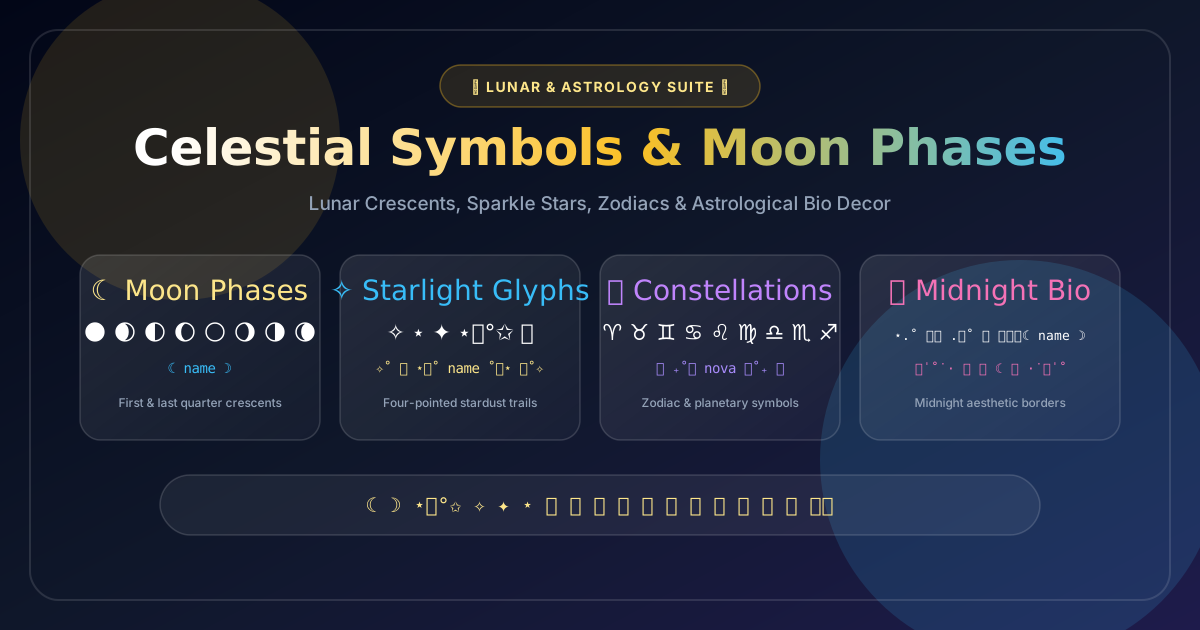
Copy aesthetic moon crescents (☾, ☽), viral starlight clusters (⋆。°✩), solar glyphs (☼, 𖤓), and dreamy constellations. Style your name with our live Moon & Starry Bio Decorator.
In lunarcore text design, true balance requires using opposite crescents on either side of your name. The last quarter moon ☾ (horns pointing right) opens the bracket, and the first quarter moon ☽ (horns pointing left) closes it:
Correct & Symmetrical:⋆⁺₊⋆ ☾ luna ☽ ⋆⁺₊⋆
Imbalanced:☾ luna ☾ (both crescents curve in the same direction, creating visual asymmetry).
Flank each crescent with identical star spacers (e.g., ⋆ or .𖥔˚) for flawless alignment.
✨
2. Pairing Small-Caps with Celestial Glyphs
Standard uppercase Latin letters (LUNA) can appear disproportionately large next to delicate moon glyphs. Converting letters to small caps (ʟᴜɴᴀ) locks the text to a uniform 1ex height that matches the exact optical scale of ☾ and ☽:
Small caps glyphs maintain standard line-height across iOS and Android without causing irregular line padding.
Enable the “Small Caps: ON” switch in our live decorator above to preview and format with zero extra clicks.
📱
3. Mobile Bio Character Budget for Stars & Moons
Smartphone viewports (specifically 375px to 390px screens like iPhone 13/14/15) allocate only 28 to 32 characters per line before forcing an automatic wrap.
Keep celestial name headers under 24 total character units to prevent trailing crescents from wrapping onto a second line.
When designing multi-line bios, place complex starry clusters (like ⋆.˚ ᡣ𐭩 .𖥔˚ ࣪ ִֶָ☾) on their own dedicated divider line.
🪐
4. Formatting Astrological “Big Three” Placements
Astrology bios commonly showcase Sun, Moon, and Rising (Ascendant) signs. Clean astronomical Unicode glyphs produce a minimalist, editorial aesthetic:
Sun Placement:☉ ♌︎ (Leo Sun)
Moon Placement:☽ ♓︎ (Pisces Moon)
Ascendant / Rising:↑ ♏︎ (Scorpio Rising)
Bio Formula:☉ ♌︎ • ☽ ♓︎ • ↑ ♏︎ ⋆。°✩
Explore Related Aesthetic Studios & Decorators
Need matching starry line breaks, cute usernames, or platform-tested character counters? Explore our complete symbol suites:
Everything you need to know about Unicode moon crescents, font rendering differences, and starry bio formatting.
Why do Unicode moon crescent symbols (☾, ☽) look different on iPhone, Android, and Windows?▼
Unicode characters like U+263E (Last Quarter Moon ☾) and U+263D (First Quarter Moon ☽) are rendered by the native system font of each operating system. On Apple devices (iOS and macOS), the San Francisco font renders them as clean, slender, calligraphic outlines with tapered tips. On Android (Roboto and Noto Sans), they often appear slightly thicker and more circular. On Windows (Segoe UI Symbol), they feature a wider optical aperture. To maintain cross-platform visual consistency in bios, designers often flank crescents with balancing stars (e.g., ⋆⁺₊⋆ ☾ name ☽ ⋆⁺₊⋆) so the framing remains centered regardless of the platform font engine.
How do you combine celestial symbols with small-caps text for aesthetic bios?▼
Small-caps Unicode characters (such as ᴀ ʙ ᴄ ᴅ or ʟ ᴜ ɴ ᴀ) use specific phonetic and Latin extension glyphs that match the optical x-height of standard lowercase letters while maintaining capital letterforms. Because celestial symbols like ☾, ☽, ⋆, and ✧ have vertical bounding boxes similar to small-caps glyphs, pairing them creates a balanced, harmonious baseline (e.g., ⋆。°✩ ʟᴜɴᴀ ✩°。⋆ or ☾ ᴀsᴛʀᴀ ☽). You can use our live Celestial Styler with the 'Small Caps' toggle enabled to generate one-click formatted names without needing external keyboard converters.
What is the character width rule for starry dividers and borders on mobile bios?▼
Most mobile social profile headers (including Instagram bio lines, TikTok bio screens, and Discord status messages) wrap text after approximately 28 to 32 standard character units on narrow smartphone viewports (360px–390px width). Complex multi-codepoint sequences—such as combining diacritics (e.g., ๋࣭ or ִֶָ) and multi-byte emojis (🪐, 🌌)—consume significant optical horizontal width. For safe, single-line starry dividers, keep total characters between 16 and 24 units (e.g., ─── ⋆⋅☆⋅⋆ ─── or ✧˚ ༘ ⋆。˚ ☁︎ ˚。⋆ ༘˚✧) to prevent unexpected line wraps and broken symmetries.
Why do some symbols like 𖤓 or ᡣ𐭩 show up as blank boxes (tofu) on older devices?▼
Symbols like 𖤓 (Bamum script solar wheel U+16913) and ᡣ𐭩 (Mongolian script butterfly pair U+1863 + U+1B69) reside in supplementary Unicode planes (SMP) that require Unicode 13.0+ or modern font packages like Noto Sans Bamum. Devices running operating systems older than iOS 16 or Android 12 may display these characters as empty rectangles (known as 'tofu'). For universal compatibility across older Android phones and legacy Windows PCs, stick to Core BMP celestial characters such as ☾ (U+263E), ☽ (U+263D), ☼ (U+263C), ✧ (U+2727), and ⋆ (U+22C6), which render reliably on virtually all hardware.
Can I use celestial symbols in gaming usernames like Roblox, Discord, and Steam?▼
Yes, but platform policies differ: Discord Display Names support virtually all Unicode celestial symbols, moon crescents, and starry frames up to 32 characters. Steam Community profiles permit full Unicode formatting in profile names and bio boxes. Roblox Display Names allow standard letters and select accented scripts, but strictly filter out non-standard punctuation and complex combining diacritics. In Roblox, use simple alphanumeric names paired with allowed brackets, while keeping complex celestial combos for Discord, TikTok, and Instagram.
How do I copy and paste celestial symbols into my social media bio?▼
Simply click or tap any celestial symbol, starry frame, or moon phase combo card in our studio to automatically copy it to your clipboard. Next, open your target app (Instagram, TikTok, Twitter/X, or Discord), navigate to 'Edit Profile', paste the copied string into the Name or Bio field, and save changes. Our studio automatically strips invisible trailing spaces and newlines to prevent awkward truncation bugs.
What do the astrological and planetary glyphs (☉, ☽, ☿, ♀, ♂, ♃, ♄) represent?▼
These glyphs are historical astronomical and astrological symbols representing celestial bodies: ☉ represents the Sun (vitality, core ego), ☽ the Moon (emotions, intuition), ☿ Mercury (mind, communication), ♀ Venus (love, beauty, harmony), ♂ Mars (drive, passion), ♃ Jupiter (expansion, luck), ♄ Saturn (discipline, karma), ♅ Uranus (innovation), ♆ Neptune (dreams, mysticism), and ♇ Pluto (transformation). In aesthetic profiles, they are frequently used alongside zodiac signs (♈–♓) to display astrological 'big three' placements (Sun, Moon, Rising).